
Most vehicle owners store their cars at home without much deliberation. The garage exists. The car fits. The arrangement begins by default.
For a vehicle with collector-grade paintwork, significant mechanical complexity, and a market value that reflects both — the choice deserves more thought. Collector car storage in Pretoria is not a logistics decision. It is a custody decision. And home garages were not built with custody in mind.
Collector car storage in Pretoria begins where the home garage ends
A home garage offers three things: a roof, a lock, and a concrete floor. For a daily driver that needs to start on a cold Tuesday morning and park somewhere secure overnight, that is adequate.
For a vehicle worth protecting across years of inactivity, the garage is a starting point — and rarely a sufficient one. It does not provide battery conditioning, tyre management, monitored security, humidity control, or any kind of condition record. What it provides is proximity: the owner is nearby. Nothing intervenes on the vehicle’s behalf.
Proximity is not a maintenance protocol.
What the Highveld does to a parked car
Pretoria’s climate appears mild until storage enters the equation.
Highveld summers bring intense UV exposure, hailstorm risk in the afternoon months, and the humidity cycling that accompanies the rainy season. That cycling — ambient moisture rising and falling repeatedly across weeks — is the condition most damaging to a vehicle at rest. Moisture works its way behind trim panels, into chrome junctions, beneath compressed rubber seals, and under painted surfaces. It retreats when the air dries, but the residue accumulates over seasons: chrome clouds, rubber loses elasticity, and paint oxidises unevenly where UV reaches it through garage ventilation and cracked doors.
Highveld winters are cold and dry — a different category of damage. Battery cell chemistry degrades in vehicles that sit unmoved. Rubber seals and hoses stiffen silently. Oil that is not circulated loses the protective film that coats internal metal surfaces during operation. None of this is acute. All of it compounds over three to six months.
A home garage does not manage these processes. It contains the vehicle without intervening in any of them.
The inventory problem
When a car sits in a home garage, nothing happens unless the owner makes it happen.
Battery discharge is gradual and easy to miss until the car won’t start — by which point the cells have already undergone degradation that a recharge won’t fully reverse. Tyre flat-spotting accumulates at static contact points when a vehicle doesn’t move. Three months of uninterrupted weight on the same patch of rubber — particularly in performance tyres on softer compounds — leaves a deformation that affects road feel and, in more pronounced cases, structural integrity. Fluid levels drop. Coolant degrades. Oil that sits unmoved forms a surface layer that doesn’t lubricate the way it should on a cold restart.
None of this is dramatic. None of it announces itself. At retrieval — after an international posting, a renovation, a season elsewhere — the vehicle is behind where it started. Not broken. Quietly diminished.
Documentation is the second failure. A home garage produces no intake condition report, no photographic record, no log of what was checked and when. If a paint scuff exists at retrieval that wasn’t there at parking, there is no reference point. The condition history is whatever the owner remembers, which is rarely precise enough to matter in an insurance claim or a resale conversation.
On flat-spotting, specifically
Flat-spotting warrants attention because its effects accumulate slowly and are easy to misattribute. A performance tyre at rest under static vehicle load develops a flattened contact patch after several weeks. After three to six months — sooner in the softer compounds used by most GT and supercar manufacturers — that deformation becomes pronounced enough to affect balance and road feel. Vehicles on low-profile performance rubber are most susceptible. Repositioning the vehicle at regular intervals prevents this. It does not happen automatically in a home garage, and few owners think to add it to a pre-departure checklist.
What a stewardship arrangement actually involves
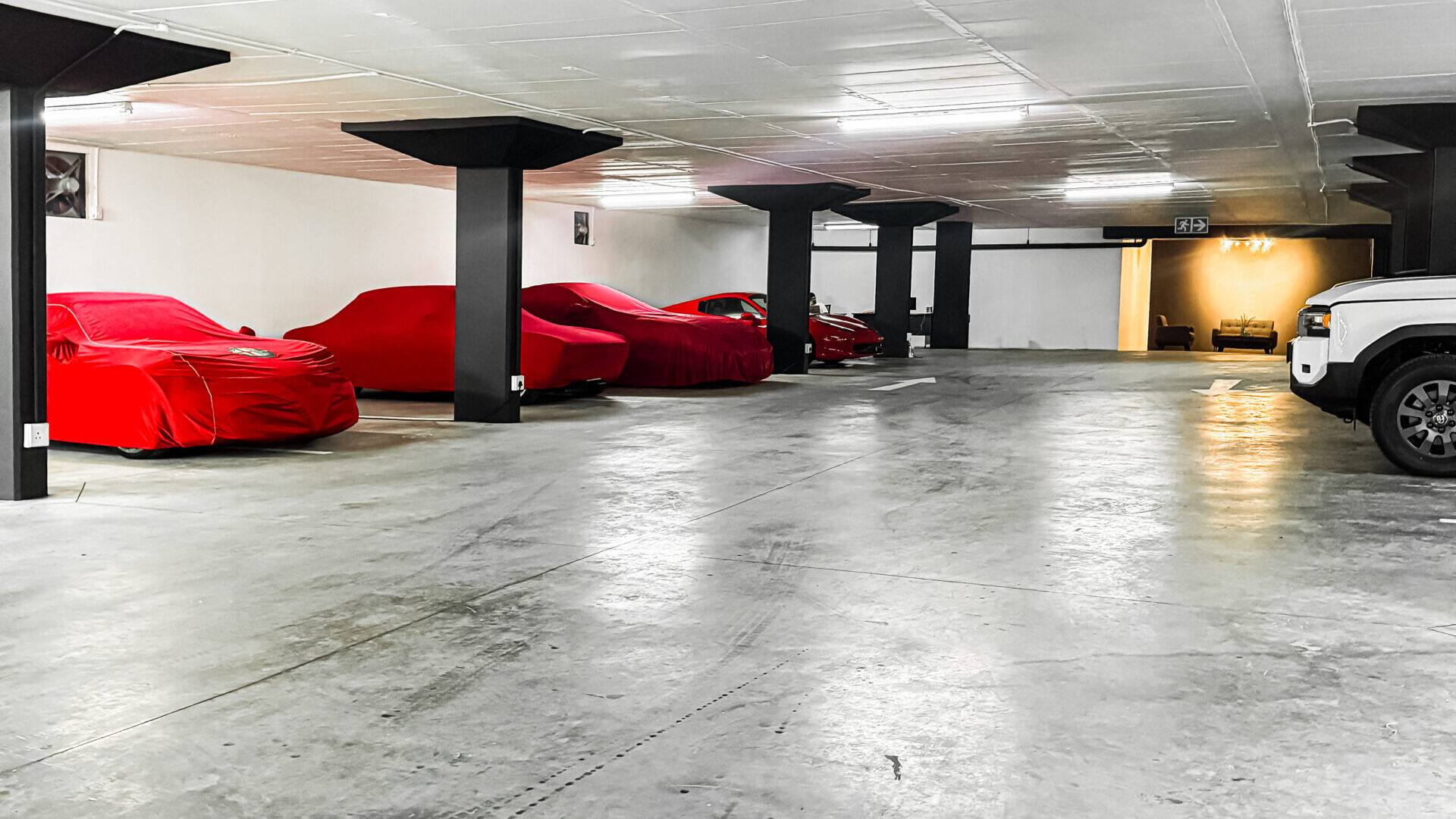
Collector car storage in Pretoria, at a facility built for the purpose, operates on a different premise: the vehicle is an asset under active custody.
Battery conditioning runs continuously through trickle-charging systems calibrated to maintain cell health across any storage duration. Tyres are monitored and the vehicle is repositioned at regular intervals to prevent flat-spotting. Monthly operational checks include engine runs to operating temperature, fluid inspection, and a visual condition review. Every step is logged — on intake, at each check, and on exit.
Monitored security operates around the clock. Access is controlled, by arrangement, and logged. No vehicle enters the facility without a full condition assessment and photographic record, and nothing leaves without an exit review against that baseline. That accountability only exists when someone is specifically responsible for the car — not merely in proximity to it.
For owners who require more than storage, precision detailing and paint protection film can be arranged without the vehicle leaving considered care. The car stays in one place. Oversight stays unbroken.
When a home garage becomes the wrong answer
There are circumstances in which the inadequacy of home storage stops being theoretical.
Extended absence is the most common trigger. An owner away for three to six months cannot intervene if a battery begins failing in month two, cannot reposition the tyres, cannot respond to a pest intrusion that started quietly while the car sat unvisited. The vehicle waits. What it becomes during that period depends entirely on what was in place before departure.
Multi-car households face a related problem: residential garages rarely keep pace with collections. A double garage built for daily transport was not designed for a vehicle requiring generous bay clearance, a dedicated trickle charger, and someone reviewing it monthly.
Some collector vehicle insurance policies specify storage conditions — indoor, secured, monitored — that a typical home garage does not satisfy. The policy language is worth reviewing before a long-term arrangement begins.
Custody, not convenience
The decision to use a storage facility is not, at its core, about convenience. It is about what the vehicle is.
A daily car that sits for two months and starts without drama has served its purpose. A collector-grade vehicle sitting for the same period without conditioning, monitoring, or documentation has quietly accumulated risk — in its cells, its rubber, its condition record, and its eventual resale position.
The Vault is Auto Vault’s facility in Brooklyn, Pretoria — built on that distinction. It is not a parking operation. Vehicles enter under a custody arrangement, structured around the specific requirements of cars that deserve stewardship, not just shelter. Luxury car storage in Pretoria, done properly, is the difference between a vehicle that holds its position and one that silently retreats from it.
Bay availability is limited. Those considering an arrangement for a vehicle worth protecting are welcome to start with a conversation.