Most of the content written on this topic is generic. It was written for drivers in California or the United Kingdom, by people who have never had to think about a Highveld hailstorm in November, who have never watched a Jacaranda tree deposit six weeks of pollen onto a freshly coated bonnet, who have never driven the N1 between Pretoria and Johannesburg at 120 km/h behind a gravel truck that should not be on a highway.
The question of PPF versus ceramic coating has a different answer in Gauteng. Not entirely different — the physics of both products do not change because of geography — but the priorities shift. The threats are different here. The decision should reflect that.
This is the version written from the environment your car actually lives in.
What Each Product Actually Does
Before the SA context, the foundation.
Paint Protection Film (PPF) is a thermoplastic urethane film — typically 6 to 8 thousandths of an inch thick — that is applied directly to painted surfaces. It is a physical barrier. Its job is to absorb and deflect the things that hit your car: stone chips, road debris, scratches, minor abrasion. Modern PPF films are self-healing — low-level surface marks disappear with heat from the sun or a heat gun as the film returns to its original form. A well-installed film from a reputable brand is virtually invisible and can last 8 to 12 years before replacement is warranted.
PPF does not make your car shinier. It does not improve gloss or make water bead. On its own it is not hydrophobic. What it does is preserve the factory paint underneath it, intact, against physical damage.
Ceramic coating is a liquid polymer — typically silica dioxide or silicon carbide based — that bonds chemically with your car’s clear coat to form an extremely thin, hard, slick layer. It is not a physical barrier against impact. A stone chip will pass through it as though it is not there. What ceramic coating excels at is chemical and environmental protection: it creates a hydrophobic surface that sheds water, contaminants, bird droppings, tree sap, brake dust, and industrial fallout before they can bond to or etch the paint. It also deepens gloss and makes maintenance significantly easier.
A well-applied professional ceramic coating lasts 2 to 9 years depending on grade, maintenance, and conditions. Professional application in Pretoria and Johannesburg typically includes a decontamination wash and paint correction stage — which adds cost but is not optional if you want the coating to bond properly and look the way it should.
They are not competing products. They protect against different threats. That distinction matters more here than anywhere.
The SA Environment: What Your Car Is Actually Up Against
Highveld hail
This is the variable that dominates every paint protection conversation in Gauteng, and it is almost entirely absent from the international content on this topic.
Between October and February, the Highveld produces convective thunderstorms that form rapidly and move fast. Hailstones in Pretoria and Johannesburg regularly reach marble to golf ball size during severe events. Significant storms hit the northern suburbs — Waterkloof, Menlyn, Brooklyn — without warning, and without covered parking, a car can sustain dozens of dents in under three minutes.
This is the critical point that most paint protection content misses: neither PPF nor ceramic coating prevents hail damage. PPF protects paint. It does not absorb the kinetic energy of a 30-gram hailstone falling at terminal velocity. Your car will dent regardless of what is on the paint surface.
What PPF does is ensure that when the hail hits, the paint underneath is not chipped, cracked, or compromised — which matters enormously for the repair and resale value conversation after the event. A car with factory paint intact under PPF repairs cleaner and values higher than one without it.
The practical Highveld answer on hail is not a coating decision. It is a storage decision. A covered bay protects paint. A properly applied PPF protects the paint that hail does not reach.
Stone chips and road debris
The N1, N14, and R21 corridors are not kind to front ends. The volume of commercial traffic, the road surface quality in construction zones, and the prevalence of poorly loaded vehicles shedding aggregate on highways makes stone chip damage a near-certainty for any Gauteng driver who uses their car regularly.
This is where PPF earns its cost most clearly. A partial front package — bonnet, front bumper, front fenders, and mirrors — protects the surfaces that take 90 percent of highway chip exposure. For a performance car that you intend to drive rather than store, this protection is not cosmetic. It is structural. Chips through to bare metal invite rust. On a car with a colour like Chalk, Python Green, or Miami Blue, a repair that does not perfectly match factory paint is visible and permanent in value terms.
UV and oxidation
Pretoria’s UV index regularly reaches 11 to 12 in summer — among the highest of any major city in the world. On a car with no paint protection, prolonged UV exposure fades colour and breaks down clear coat over a timeline measured in years, not decades. This is the domain ceramic coating owns. Its UV-blocking properties are well documented. On surfaces not covered by PPF — the roof, the doors, the rear bumper — a quality ceramic coating applied over properly corrected paint is the most effective defence against the UV conditions specific to the Highveld plateau.
Dust, pollen, and industrial fallout
Pretoria is one of the most pollen-heavy cities in the southern hemisphere during Jacaranda season — October to November — which inconveniently coincides with the peak surface-protection window. Jacaranda pollen is mildly acidic and stains paint if left to bake on in 30-degree heat. Industrial fallout from the Pretoria West corridor deposits iron particles and chemical compounds that embed in paint and begin oxidising within weeks.
A ceramic coating’s hydrophobic surface means these contaminants cannot bond as effectively. They bead and wash away. On an unprotected or wax-only surface, they require abrasive decontamination to remove — which takes clear coat with it each time.
The Honest Decision Framework
Given the above, here is how to think about what your car actually needs.
If you drive your car regularly on Gauteng highways
PPF on the front end is not a luxury decision for a daily-driven performance car in Pretoria or Johannesburg. The chip exposure on the N1 alone makes it a maintenance decision. Ceramic coating over the top of the PPF — which is both possible and recommended — adds the hydrophobic layer the film lacks on its own.
If your car is primarily a weekend or occasional driver
The chip exposure is lower. The case for full PPF weakens. A professional ceramic coating on properly corrected paint, applied by someone who knows what they are doing, gives you UV protection, chemical resistance, hydrophobicity, and gloss enhancement for R12,000 to R30,000 depending on vehicle size and coating grade. It will last 3 to 5 years with correct maintenance. For a car that covers 5,000 km a year, that is a sensible protection position.
If you are preparing to sell
Paint correction followed by a fresh ceramic coating is the most cost-effective pre-sale investment in this market. It restores the perceived condition of the paintwork, presents the car under viewing in its best light, and signals to a knowledgeable buyer that the car has been properly maintained. The return on a R8,000 to R15,000 paint correction and coating package — factored into a private sale price — is typically favourable on a performance car above R1,000,000.
If you are taking delivery of a new car
The best time to apply PPF is before the paint has accumulated a single chip. On delivery, the paint is factory-fresh. Applying PPF immediately — before the first drive — means the film protects original factory paint for the life of the film. Waiting three years and then applying film locks in whatever damage has already occurred.
The Order of Operations
One point that generates genuine confusion: the sequence matters.
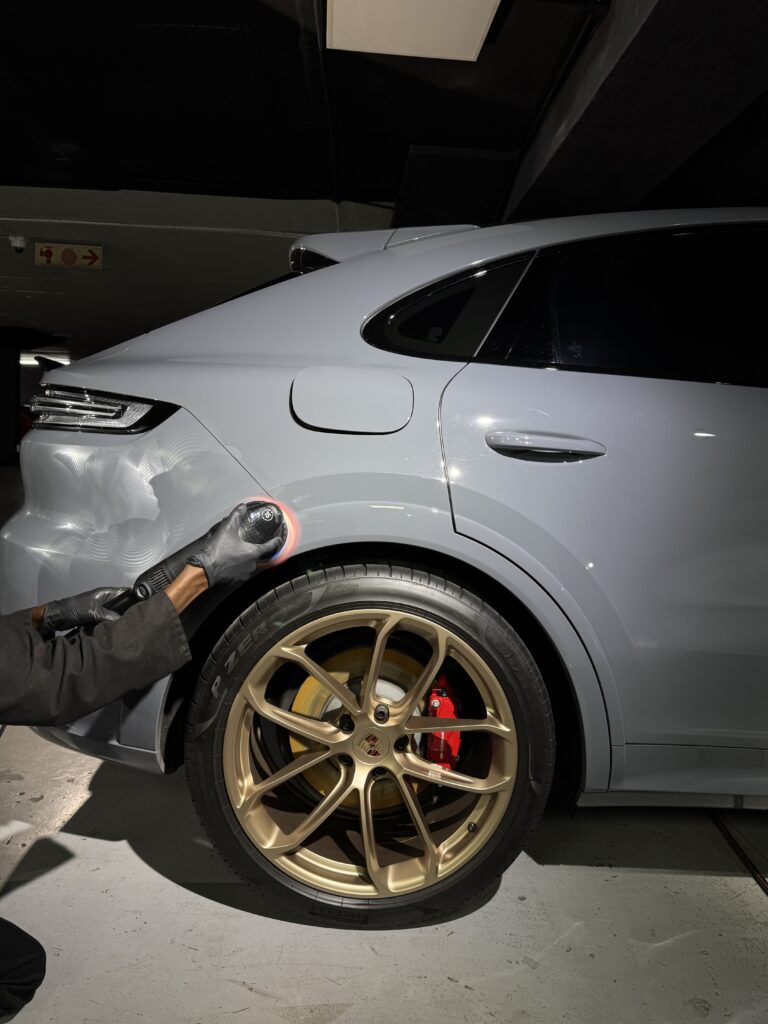
Paint correction comes first — always. Ceramic coating and PPF lock in whatever is beneath them. Swirl marks, light scratches, industrial fallout embedded in the clear coat, and transport-related marring from the delivery process are all invisible on a dusty car and entirely visible under a gloss ceramic coating in sunlight. Correction before protection is not upselling. It is the only way the result looks the way it should.
After correction: PPF goes on first, to the surfaces you are protecting from impact. Ceramic coating goes over everything — including over the PPF — last. The ceramic gives the PPF hydrophobic properties it lacks on its own, and protects every surface not covered by film.
Paint correction in Pretoria runs R6,000 to R13,500 depending on paint condition and vehicle size. That cost, absorbed before protection is applied, determines the quality of everything that comes after it.
How Surface by Auto Vault Approaches This
The brands matter less than the process. A premium film installed on poorly prepared paint will lift at the edges within 18 months in Gauteng’s UV conditions. A ceramic coating applied over contaminated or incompletely corrected paint will lock the imperfections in permanently — visible under direct light from the first week.
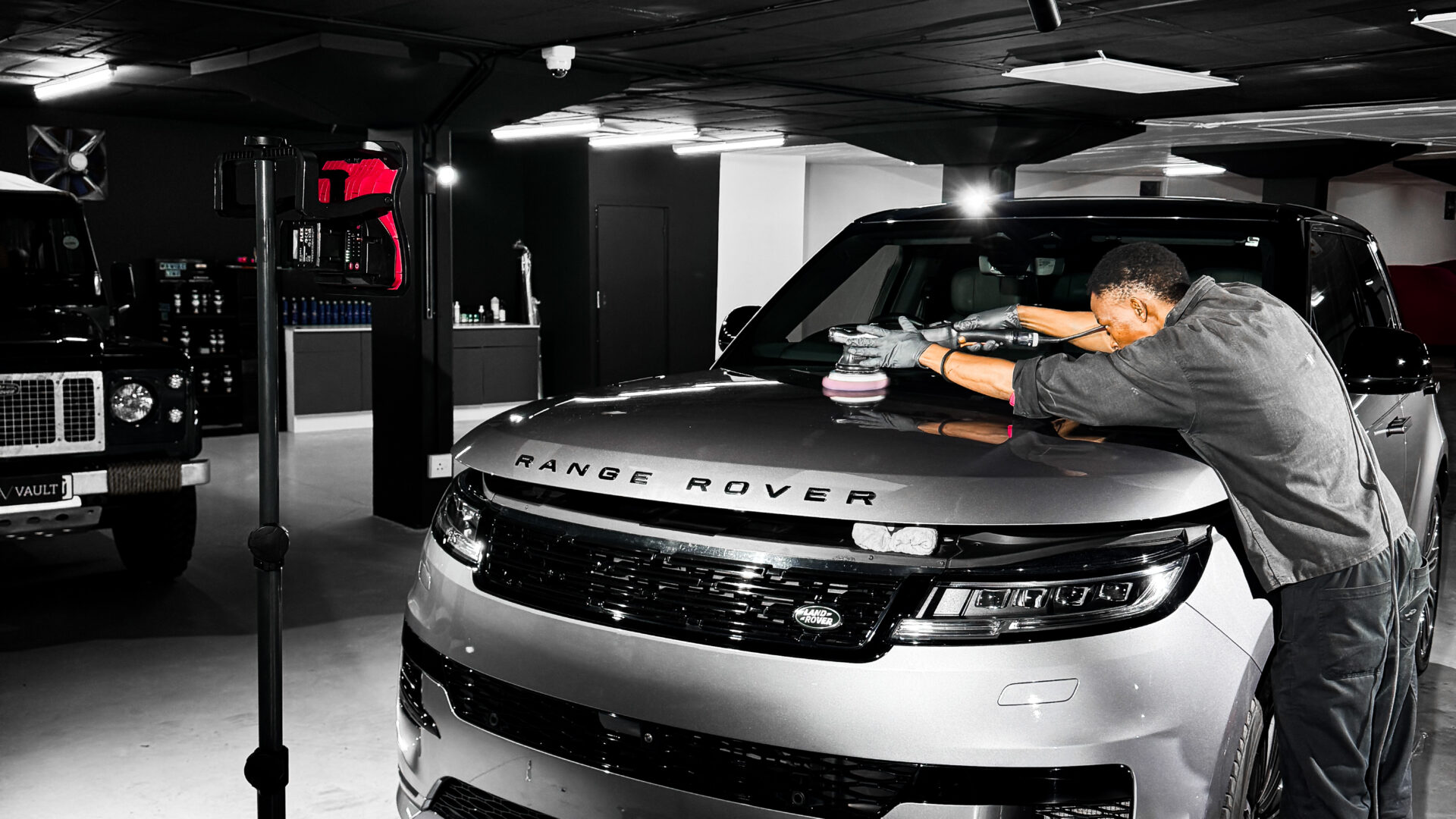
Every vehicle that comes through Surface begins with full paint decontamination before any protection is discussed: iron fallout removal, chemical cleansing, clay preparation, paint depth measurement. Defects are mapped under studio lighting — a condition most workshops cannot replicate, and one that makes a material difference in identifying what the paint actually needs versus what it appears to need.
PPF installation at Surface uses ShieldTeck — a self-healing thermoplastic urethane film with a 10-year manufacturer warranty against delamination, yellowing, and cracking. Paint correction before film application is available and recommended for vehicles where existing defects need to be resolved before they are enclosed beneath a film that will be in place for a decade. The decision on whether correction is needed before PPF is made per vehicle, per surface — not as a default upsell.
Ceramic protection is drawn from the Labocosmetica product range — including the Maniac, Geist, and Aventore lines — selected against the specific paint system, vehicle use, and intended longevity. Application is multi-stage on a corrected surface, carried out in the Brooklyn facility by appointment only. The studio environment controls for temperature and contamination during cure — both of which directly affect coating adhesion and long-term performance.
All work is assessed individually before scheduling is confirmed. There is no standard package that applies to every car, because no two cars arrive in the same condition or with the same requirements.
The PPF versus ceramic question does not have a universal answer. It has an answer that depends on how you use your car, where you use it, and what you are trying to achieve. For most Gauteng-based performance car owners who drive their cars, the answer is not one or the other — it is both, in the right order, on the right surfaces.
If you would like to discuss what Surface by Auto Vault recommends for your specific car and usage pattern, we are happy to have that conversation. By arrangement.