
There is a version of vehicle ownership that assumes the car is safe when it is not moving. That a garage is protection. That leaving something stationary, covered, out of the way, preserves it.
The reality is more complicated — and in Pretoria, it is significantly more complicated than in most places a performance car owner might read about online. The international content on this topic was written for garages in the United Kingdom or the American Midwest. It does not account for the Highveld UV load, the summer thunderstorm pattern, the humidity swing between January and September, or the particular problem that load shedding introduced into any home storage arrangement that relies on mains power.
What follows is an account of what actually happens — physically, chemically, mechanically — to a performance or collector car left at rest in Pretoria’s climate. It is not alarmist. It is specific.
The Battery: The First Thing to Go Wrong
Modern performance cars carry electronics that draw current continuously — security systems, immobilisers, tyre pressure monitoring, adaptive suspension controllers, and the background processes of engine management systems that never fully sleep. This parasitic draw is measured in milliamps, but it accumulates over weeks and months.
A healthy battery left in a stationary car will lose its charge over approximately four to six weeks under normal conditions. At that point, depending on the battery’s age and state of health, it may or may not recover fully from a conventional charge. What happens to a battery left for longer — three months, six months — is more serious.
The process is called sulfation. When a lead-acid battery is discharged to a low state and remains there, lead sulphate crystals form on the battery plates. These crystals are not fully reversible. A battery that has sulfated can often be jump-started — briefly — but it will not hold a meaningful charge, and it will likely fail within days of the car returning to use. The battery is damaged in a way that a standard recharge cannot undo. Replacement is the only resolution.
For modern Porsches, BMW M cars, and AMG variants — where the battery is registered to the vehicle’s BMS and the replacement process requires dealer-level coding — the cost and inconvenience of an avoidable battery failure is material. This is not a R600 battery swap. It is a workshop visit.
The Highveld complication: load shedding. A trickle charger or battery maintainer connected to mains power is the standard solution for a stored performance car. It keeps the battery at optimal state of charge continuously, preventing the discharge cycle that leads to sulfation. But a trickle charger plugged into a wall socket in Pretoria is only as reliable as the grid it draws from.
Load shedding returned to Pretoria in March 2025 after a ten-month absence. At peak stages, outages ran to four to six hours per cycle, twice daily. A battery maintainer interrupted during every scheduled outage does not maintain the battery — it cycles it through partial charge and partial discharge repeatedly. For a battery already in reduced health, this cycling pattern accelerates degradation rather than preventing it. A stored car on a home trickle charger during active load shedding is meaningfully less protected than the owner believes it to be.
Tyres: Flat-Spotting, Dry Rot, and Pressure Loss
A tyre is carrying the weight of the car across a contact patch of roughly the size of an adult’s hand. When the car sits in one position for weeks, that same section of tyre bears the load continuously. The rubber in the contact area compresses and — particularly at low temperatures — does not fully recover when the load is finally removed. The result is a flat spot: a section of tyre that is no longer perfectly round.
Mild flat-spotting produces a rhythmic vibration when driving — noticeable at lower speeds, often diminishing as the tyre warms and the rubber relaxes. Severe flat-spotting does not resolve with heat. The deformation is permanent. The tyre requires replacement.
The threshold for flat-spot formation is not months. On a heavy performance car with stiff sidewalls — a 911, a GT car, a supercar with wider rear section tyres — flat-spotting can begin in as little as four to six weeks at temperatures below 10°C. Pretoria’s winter mornings reach 5 to 7°C in June and July, and the overnight minimum has been recorded below zero in cold years. A car sitting on cold concrete through a Pretoria winter, on tyres that have been slowly losing pressure since it was last driven, is accumulating flat-spot risk at a measurable rate.
Compounding this is tyre ageing. Rubber degrades through a combination of UV exposure, ozone in the atmosphere, and heat cycling — regardless of mileage. A tyre sitting stationary in a Pretoria garage still experiences temperature swings of 15 to 20°C between day and night in winter, and UV exposure from any light source. Tyres six years old or older may appear externally acceptable but carry microscopic sidewall cracking that compromises structural integrity at speed. This is not visible in the garage. It becomes visible, in the worst cases, at motorway speeds.
Brakes: Surface Rust and Seized Calipers
Brake rotors are iron. Iron and moisture produce iron oxide. A car parked for two weeks in a Gauteng summer — humidity averaging 62% in January and February — will develop surface rust on its rotors. This is normal and usually resolves after a few brake applications when the car returns to use.
What happens over months is different. The surface rust layer deepens and becomes uneven. Brake pads partially embedded in rust during a prolonged stop can bond to the rotor surface. When the car is first moved, the pads tear free — taking rotor surface with them, leaving uneven wear patterns and scoring that affects braking consistency. On performance-grade rotors, which are both more expensive and more dimensionally critical than standard components, this kind of damage matters for feel, for fade resistance, and for the car’s ultimate braking behaviour.
More serious is caliper seizure. The rubber seals inside brake calipers — which keep brake fluid in and moisture out — dry out and lose their flexibility when left stationary. Moisture migrates in. Caliper pistons corrode in their bores. A piston that was designed to retract cleanly after brake application no longer does. The pad drags. Brake temperatures rise. In severe cases, the seized piston refuses to engage properly at all. Rebuilding or replacing seized calipers on a Porsche PCCB system or a high-specification performance brake package is not a routine service cost.
The handbrake — particularly on older cable-operated systems — can seize entirely if left applied for several months. A car freed from a seized handbrake by force rather than normal release may have bent or snapped cables, damaged rear caliper mechanisms, and scored rear rotors.
Fuel: Degradation, Varnish, and Injector Risk
Petrol has a functional shelf life of approximately three months under normal storage conditions. Beyond that, the lighter volatile compounds begin to evaporate. The remaining fuel becomes denser, less combustible, and prone to forming gum and varnish deposits — sticky residues that coat fuel system components and accumulate in injectors.
Modern direct-injection engines use injectors operating at pressures up to 200 bar with orifice diameters measured in microns. These are not forgiving of partial blockages. Degraded fuel through a direct-injection system does not simply produce rough idling and a difficult start — it produces injector deposits that require chemical cleaning or physical replacement to address fully.
Ethanol-blended petrol, which is increasingly common in the South African supply chain, accelerates this problem. Ethanol is hygroscopic — it absorbs moisture from the air. A partially-used tank of ethanol-blended fuel sitting for four months in a Gauteng summer absorbs ambient humidity through the fuel filler, introduces water into the fuel system, and produces the conditions for internal corrosion and phase separation. The fuel that results is not fuel in any useful sense. It is a mixture with the combustion characteristics of neither petrol nor water and the corrosive potential of both.
What the Highveld Adds
Most of the above would apply to any parked car in any climate. Pretoria adds specific aggravating conditions that most storage advice ignores entirely.
Altitude and UV. Pretoria sits at 1,339 metres above sea level. UV intensity increases by approximately 10 percent for every 1,000 metres of elevation. The Highveld is already at the extreme end of UV exposure globally — the Gauteng plateau registers UV indices of 11 to 12 in November through January, among the highest of any major urban area in the world. Even inside a garage, UV from indirect light sources and from heat-driven degradation processes attacks rubber compounds, clear coat, and leather at an accelerated rate relative to lower-altitude climates. A car stored in an uninsulated Pretoria garage in December is experiencing UV load equivalent to extended outdoor storage in most European climates.
The humidity swing. Pretoria’s relative humidity ranges from 62 percent in January and February to 35 percent in September — a swing of nearly 30 percentage points across the calendar year. An uninsulated garage cycles through this range with ambient conditions. Every humidity cycle drives moisture into seals, leather, carpets, and trim. Every dry cycle pulls it out. This repeated swelling and contracting — invisible, continuous — degrades organic materials faster than stable elevated humidity or stable low humidity would. It is the cycling that does the damage, not either extreme alone.
Winter mornings below freezing. Pretoria winters are dry and often clear. The Highveld’s elevation means that radiation cooling on clear nights can push temperatures to 5°C in the garden — and to lower effective temperatures on concrete garage floors where cold air pools. A battery already compromised by months of storage is most vulnerable to failure in these conditions. A tyre flat-spotted by months on cold concrete is most likely to produce permanent deformation when the car first rolls in these temperatures.
The summer thunderstorm and hail window. October to March is Pretoria’s rain season. Afternoon thunderstorms form rapidly over the Magaliesberg and can deliver hail with 15 to 20 minutes’ warning — sometimes less. For a car kept at a residential property without enclosed, hardened shelter, this is the primary physical damage risk. An unprotected car on a driveway during a significant Highveld hailstorm accumulates damage in minutes that takes months to assess, quote, and repair. Insurance covers the body damage, eventually. It does not cover the disruption, the depreciation during repair, or the fact that repaired hail damage is never invisible to a trained eye during a pre-sale inspection.
What Proper Storage Actually Addresses
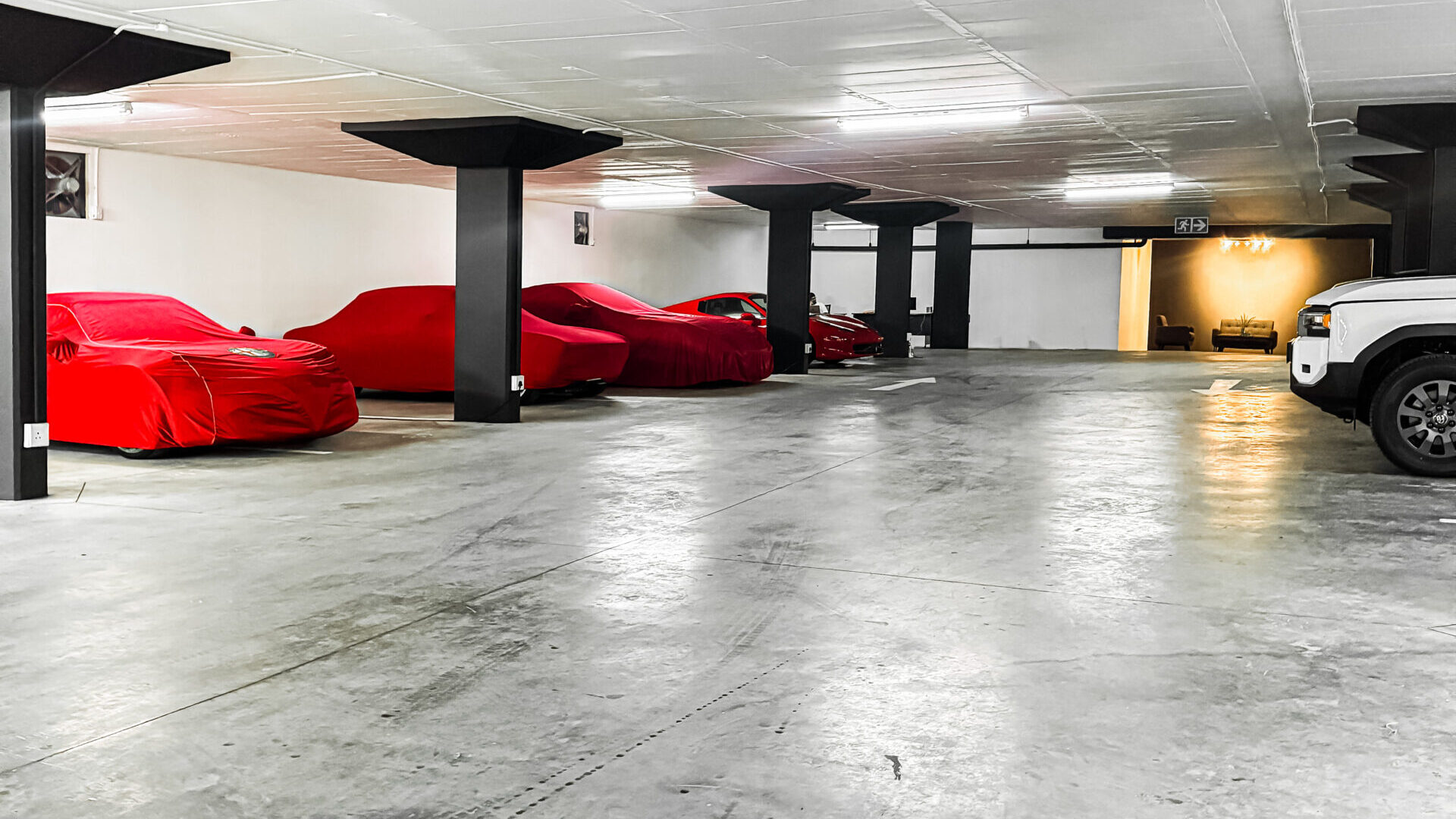
The Vault in Brooklyn, Pretoria, was built around these specific failure modes — not as an abstract precaution, but as a structured response to what actually goes wrong with valuable cars left at rest in this climate.
Battery conditioning runs continuously through trickle charging with mains-independent oversight — not a wall-mounted charger subject to outage interruption. Tyres are repositioned at scheduled intervals to prevent sustained contact-patch loading. Monthly operational checks include engine runs, fluid level inspections, and brake system assessments. The facility maintains a stable, climate-appropriate environment — controlling the humidity fluctuation and UV exposure cycles that an uninsulated home garage cannot manage. Security is continuously monitored. Every vehicle enters under a documented condition assessment and is maintained against that record.
The facility is enclosed and hardened — not a carport, not a domestic garage with a roller door, not a general storage unit. During the Pretoria summer storm season, the vehicles inside are not at hail risk. During winter, they are not cycling through temperature extremes on uncontrolled concrete.
This is not a comprehensive service for every car. It is a specific answer for vehicles where the cost of getting storage wrong — in battery replacement, in tyre damage, in brake repairs, in paint degradation, in reduced resale position — is greater than the cost of getting it right. For most performance and collector cars above a certain value, that calculation resolves clearly.
A car left in a Pretoria garage for six months is not resting. It is depreciating through a series of slow, invisible processes — most of which are entirely preventable with the right environment and the right care schedule.
If you are planning extended travel, managing a multi-car collection, or simply want the car properly attended to while it is not in use, we are happy to discuss what an arrangement at The Vault looks like. By arrangement.